
Artificial neural networks, often called ANNs, are a key part of modern technology. They mimic how the human brain works to solve complex problems. If you’re new to this topic, don’t worry. This blog post will explain ANNs in simple terms. It will cover what they are and how they work. It will also discuss different types and their uses in everyday life. By the end, you’ll have a clear picture of why ANNs are so important today.
What Are Artificial Neural Networks?
Artificial neural networks are computer systems inspired by the brain’s structure. Just like our brains use neurons to process information, ANNs use artificial neurons to learn from data and make decisions.
The idea started in the 1940s, but it gained popularity with advances in computing power. Today, ANNs power things like voice assistants and recommendation systems on streaming services.
To understand better, think about how a biological neuron works compared to an artificial one. Biological neurons send signals through connections called synapses. Artificial neurons do something similar with math.

Comparison between biological and artificial neuron
How Do Artificial Neural Networks Work?
At the core, an ANN has layers of nodes, or artificial neurons. There’s an input layer for data, hidden layers for processing, and an output layer for results.
Data enters the input layer. Each node in the hidden layers weighs the data. It then adds a bias. After that, it applies an activation method to decide if it “fires.” This process repeats through layers.
Training happens with lots of examples. The network adjusts weights using backpropagation to reduce errors. Over time, it gets better at tasks like recognizing patterns.
Here’s a simple diagram showing the structure.

Artificial neural network architecture (ANN i-h 1-h 2-h n-o …
Types of Artificial Neural Networks
Not all ANNs are the same. Here are some common types:
Feedforward Neural Networks
These are the simplest. Data moves one way, from input to output, without loops. They’re great for basic classification tasks.
Convolutional Neural Networks (CNNs)
CNNs excel at image and video processing. They use filters to detect features like edges or shapes.
Recurrent Neural Networks (RNNs)
RNNs handle sequences, like text or time series data. They remember past inputs, making them ideal for language translation or stock predictions.
Other types include Generative Adversarial Networks (GANs) for creating new data. Long Short-Term Memory (LSTM) networks are a type of RNN for longer sequences.
Real-World Applications of Artificial Neural Networks
ANNs are used in many fields. Let’s look at some key areas.
Image Recognition and Computer Vision
ANNs, especially CNNs, identify objects in images. Think of facial recognition in phones or social media tagging photos.

What is image classification? Basics you need to know
Healthcare
In medicine, ANNs analyze scans to detect diseases like cancer. They predict patient outcomes or personalize treatments based on data.
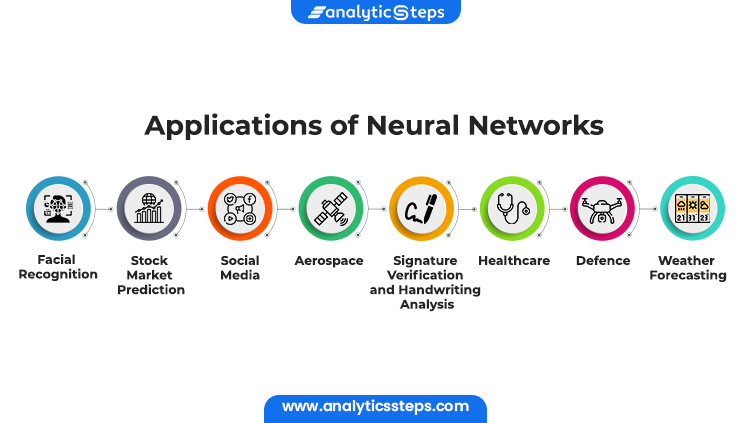
8 Applications of Neural Networks
Autonomous Vehicles
Self-driving cars use ANNs to process sensor data, detect obstacles, and make driving decisions in real time.

Biologically-inspired Neural Networks for Self-Driving Cars
Finance
Banks use ANNs for fraud detection, credit scoring, and stock market predictions by spotting patterns in transactions.
Natural Language Processing
Voice assistants like Siri or chatbots rely on ANNs to understand and generate human language.
Other applications include recommendation systems on Netflix, weather forecasting, and even gaming AI.
Advantages and Limitations of Artificial Neural Networks
ANNs are powerful because they handle large data sets and learn complex patterns without explicit programming. They’re flexible and improve with more data.
Nonetheless, they need lots of data and computing power to train. They can be “black boxes,” meaning it’s hard to understand their decisions. Overfitting, where they learn noise instead of patterns, is another issue.
The Future of Artificial Neural Networks
Looking ahead, ANNs will integrate more with AI fields like deep learning. Advances in hardware will make them faster and more efficient. Ethical concerns, like bias in data, will need addressing.
In summary, artificial neural networks are transforming industries by enabling machines to learn like humans. As technology evolves, its applications will only grow, making our world smarter and more connected. If you’re interested in learning more, start with basic online tutorials or courses on platforms like Coursera.